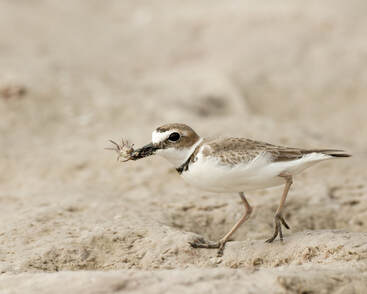
 The Wilson's Plover is one of several Georgia birds that will get a new name. Photo by Gail DuBois, Audubon Photography Awards. The Wilson's Plover is one of several Georgia birds that will get a new name. Photo by Gail DuBois, Audubon Photography Awards. By Steve Phenicie and Dottie Head
On November 1, the American Ornithological Society (AOS) announced that they will be renaming all English-language names of birds within their geographic jurisdiction that are named directly after people since some of these names carry associations with historic injustices. The Cornell Lab of Ornithology posted in support of this decision, “Determining which names to change case by case would be subjective and intractable. Changing all eponymous names is a clear standard. It also provides an exciting opportunity to generate bird names that are more informative about the birds themselves.” There has been a movement afoot by some in the world of ornithology advocating that birds should carry descriptive names instead of those of individuals. For example, the Black-throated Green Warbler and Blue-winged Warbler are excellent descriptors for these birds. Their predominant characteristics are part of the name making them easier to identify and remember, especially for new birders learning to identify birds in the field. We recognize that people will have different opinions about this process and the challenges of renaming so many species. In Georgia alone, we have more than 20 birds named for humans. Here are some birds you might at least occasionally see in Georgia that are named for people and a bit of insight into who these people were and why the birds were named after them (The list is not comprehensive). Wilson’s Storm-petrel, Wilson’s Plover, Wilson’s Snipe, Wilson’s Phalarope, and Wilson’s Warbler: When it comes to having Georgia birds named for him, Alexander Wilson is tops. Wilson (1766-1813), remembered as perhaps America’s greatest ornithologist prior to John J. Audubon, was born in Scotland and apprenticed as a weaver. He didn’t care for weaving but became interested in poetry. Wilson also wrote satirical commentary on the conditions of weavers in the mills. One of them offended a mill owner, which resulted in his arrest. He was often in trouble with the law, didn’t pay much attention to weaving, lived in poverty, and in 1794, emigrated to America. He settled in Pennsylvania, turned to teaching and met the famous naturalist William Bartram, who encouraged his interest in ornithology and painting. Resolved to publish a collection of illustrations of all the birds of North America, Wilson traveled widely, collecting and painting. The result was the nine-volume American Ornithology (1808–1814). Of the 268 species of birds illustrated in its pages, 26 had not previously been described. His bird illustrations were an inspiration for John J. Audubon and others. He is buried in Philadelphia. Swainson’s Thrush and Swainson’s Warbler: William Swainson, like Alexander Wilson, had a lot of birds named for him although these are the only two found in Georgia. Swainson (1789-1855) was born in London and is remembered for his colorful drawings of nature, especially of shells and bird feathers. During his career Swainson published more than 40 works and traveled to Brazil, New Zealand and Australia to pursue his passion. Franklin’s Gull: Named for Ben? Don’t bet the Liberty Bell on it. In 1832, on the first of two expeditions to northwestern Canada led by Sir John Franklin, ornithologists detected the bird we know as Franklin’s Gull, although they thought it was the similar Laughing Gull. On the subsequent expedition, Dr. John Richardson noted that it was a distinct species and named it Franklin’s Rosy Gull, in honor of the expedition leader. Franklin, an Arctic explorer who was born in England in 1786, was perhaps best-known for his ill-fated expedition in 1845 to find the Northwest Passage and died in 1847 near King William Island in what is now Nunavut territory, Canada. His two ships, the Erebus and the Terror, became stuck in ice, and their wreckage was not found until 2014 and 2016, respectively. Some members of his expedition turned to cannibalism in an attempt to survive. Lincoln’s Sparrow: This one has nothing to do with that famous rail-splitter from Illinois. Lincoln's Sparrow was named by John J. Audubon after his buddy, Thomas Lincoln of Dennysville, Maine. Lincoln shot the bird on an expedition to Nova Scotia with Audubon in 1834. It pays to know people in high places. Cooper’s Hawk: Again a case of rubbing elbows with the right person. The species was named by Charles Lucien Bonaparte in honor of his friend, William Cooper, who collected a specimen of it in 1828. Cooper (1798-1864) was an American naturalist, conchologist (shell zoologist) and collector. Although he was not an author himself, his specimens were of great help to others. Cooper was one of the founders of the New York Lyceum of Natural History (later the New York Academy of Sciences), and the first American member of the Zoological Society of London. Forster’s Tern: Johann Reinhold Forster (1729-1798) was a German Reformed (Calvinist) pastor and naturalist of partially Scottish descent who contributed to the early ornithology of Europe and North America. He is best known as the naturalist on James Cook's second Pacific voyage. Such expeditions promoted his career, and the findings helped set the stage for the development of anthropology and ethnology. They also laid the framework for general concern about the impact that alteration of the physical environment for European economic expansion would have on native societies. Kirtland’s Warbler: This is a case of not who you know but what you own. This bird was named by Charles Pease for his father-in-law, Jared P. Kirtland, on whose farm near Cleveland, Ohio, the first specimen was collected. Kirtland (1793-1877) was a naturalist in his own right, however, and also an Ohio politician and physician. He was a co-founder of Western Reserve University's Medical School as well as what would become the Cleveland Museum of Natural History. Brewer’s Blackbird: Thomas Mayo Brewer (1814-1880) was another crony of Audubon. Originally a doctor, he quit after a few years to concentrate on ornithology, writing, and politics. He also had a mole and a duck named for him. In his last decade of life, Brewer sparred with Elliott Coues over the fate of the House Sparrow, a recently introduced bird that was multiplying far faster than expected. While Coues and most ornithologists were in favor of killing many of them off, Brewer tried to defend them. This ornithological event is known as "The Sparrow War." Henslow’s Sparrow: Audubon named this bird for John Stevens Henslow (1796-1861), who was a British priest, botanist and geologist. He is best remembered as friend and mentor to his pupil, the famous evolutionist Charles Darwin. Bachman’s Sparrow: John J. Audubon named this one after another friend, the Rev. John Bachman. Bachman (1790-1874) was the pastor of the same church in Charleston, S.C., for 56 years and known as a social reformer who ministered to African-American slaves as well as white Southerners, and who used his knowledge of natural history to become one of the first writers to argue scientifically that blacks and whites are the same species. LeConte’s Sparrow: Audubon discovered this bird, although its naming is a bit hazy. It is generally believed that he named it after a friend, Dr. John Lawrence LeConte, although some think that he was referring to another John LeConte, also a doctor. The first LeConte (1825-1883) was a 19th century entomologist, responsible for naming and describing about half of the insect taxa known in the United States in his lifetime. The second LeConte (1818-1891) was a scientist and academic who served as president of the University of California. Blackburnian Warbler: Not many birds are named for a woman, but this one is. She was Anna Blackburne (1726-1798), an English naturalist especially noteworthy for her insect collections. A beetle is also named for her. Cory’s Shearwater: This bird is named, perhaps appropriately, for Charles B. Cory, who was the first one to describe it as a species after he collected a specimen off Chatham Island, Mass. Cory (1857-1921) grew up in a wealthy family and didn’t have to work for a living so he pursued his ornithological passion. Eventually, when his collection of 19,000 bird specimens made his house a bit cluttered, he donated them to The Field Museum in Chicago. Cory was a golfer on the 1904 U.S. Olympic team. Ross’s Goose: The goose is named in honor of Bernard R. Ross, a naturalist who was a chief trader with the Hudson’s Bay Co. in Canada's Northwest Territories. Ross (1827-1874) was an Irishman who contributed much to the early scientific knowledge of the region. Nelson’s Sharp-tailed Sparrow: This bird was named for American naturalist Edward William Nelson (1855-1934), who took part in a number of scientific expeditions, including ones to the Yosemite Valley and Death Valley. Several vertebrate species are also named for him. Baird’s Sandpiper: Spencer Fullerton Baird (1823-1887) was the first curator of the Smithsonian Institution and served as secretary and assistant secretary there. He was dedicated to expanding the natural history collections of the institution, which he increased from 6,000 specimens in 1850 to more than 2 million by the time he died. He published more than 1,000 works during his lifetime. We suggest the following links for further reading on this matter:
0 Comments
Your comment will be posted after it is approved.
Leave a Reply. |
AuthorBirds Georgia is building places where birds and people thrive. Archives
July 2024
Categories |
 RSS Feed