
Birds Georgia
  • Home
  • Our Programs
    • Conservation >
      • Wildlife Sanctuary Program
      • Habitat Restoration >
        • Q&A Habitat Restoration
      • Habitat Stewardship Program
      • Private Lands Birding Trail
      • Building Collisions >
        • Project Safe Flight
        • Lights Out Georgia
    • Education >
      • Learn
      • For Educators >
        • School Programs
        • Learning About Birds Curriculum
        • Professional Development
        • Connecting Students with STEM Through Birds
      • For Youth >
        • Georgia Urban Ecologists
        • Scouts
        • Homeschool
        • Youth Birding Competition
        • Camp Talon
      • Master Birder Program
      • Beloved Naturalist
    • GA Birding Trail
    • Bird City Georgia
    • Program Requests
  • Ways to Give
    • Become a Member
    • Donate
    • Leadership Giving
    • Planned Giving
    • Sponsorship Opportunities
    • Shop our Online Store
  • Get Involved
    • Membership >
      • Member Login
    • Volunteer
    • Community Science
  • Events & Travel
    • Field Trips
    • Upcoming Events
    • Birds Georgia at Manuel's Tavern
    • Early Birds Book Club
    • Travel >
      • St. Marks and the Florida Panhandle
      • South Dakota 2026
      • Brazil 2026
      • Pacific Northwest 2026
  • About Us
    • Centennial Celebration
    • News and Stories >
      • Press Room
      • Newsletters
      • News Feed
    • Our Mission
    • Board and Staff
    • Job Opportunities
    • Contact or Visit Us
  • Resources
    • Birding Resources >
      • Birding Sites in Georgia
      • Accessibility
      • Georgia Birding Network
      • Why Birds?
    • Habitat Resources >
      • Best Management Practices
      • Sanctuary Resources
      • Plants for Birds
    • Injured/Orphaned Birds
    • Resources for Educators
    • Conservation Career Resources
    • Threats to Birds >
      • Climate Change
      • Collision Resources
      • Coffee and Chocolate
      • Species of Concern >
        • Chuck-will's-widow
        • Ruby-throated Hummingbird
        • Chimney Swift
        • Wood Thrush
        • Brown-headed Nuthatch

There’s a New Kid in Town—Merlin

8/4/2023

2 Comments

 
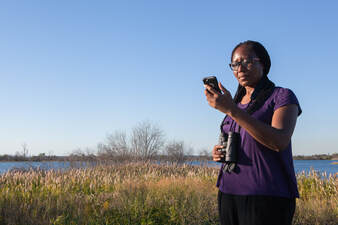
PicturePhoto by Camille Cera, National Audubon Society.
By Georgann Schmalz

It was a Northern Parula. Definitely a Northern Parula. I knew some birds’ voices pretty well in 1960's and '70s, the songs and chip notes of robins, crows, blue jays, cardinals. But what I didn’t realize was how important, if not magical and awesome, those songs were. This little warbler, just him, caught my ear in the midst of a cacophony of other spring migrants that were singing loudly. Wow, I thought, these birds are all yelling their IDs to me without my seeing them. I tuned in to another song and the next and the next. Over time it became my compelling behavior, enough to enable me to share the birding by ear process for more than 45 years. I began to understand that 90% of birding is half listening (sorry, Yogi Berra). 

Historically, in the field techniques have changed, albeit slowly in those 45 years. How often have we imagined a convenient way to isolate songs, play them back for study, dissect them with their song characteristics. I remember returning home after many field trips and immediately listening to the LP records by Donald J. Borror, searching for the songs I had heard hours before. The vinyl evolved into plastic reel-to-reel tapes and cassettes. As cumbersome as they were, at least we could take cassettes players into the field with us!  And then, came the holy CDs. Digital recordings at our fingertips, no rewinding tapes, no waste of time. In 1999, we had the Blackberry 10 devices, which then begat iOS and Android platforms. By this time, we were all thinking that what we really needed was a handheld device that had not only songs, but also photos, range maps, descriptions — in other words, an app field guide with instant information and gratification on a handheld device with speakers and microphones and just throw in a camera and phone for the heck of it.

Enter the new kid in town: the Merlin app from the Cornell Lab of Ornithology. Originally known for its visual identification of birds, it became an audio recognition of songs and chips in 2022.  

Merlin identifies bird sounds using computer learning technology to recognize species based on spectrograms or sonograms — visual representations of sounds. For Merlin to learn to recognize a species by sound, it uses audio recordings from the Macaulay Library that include a variety of sounds for each species to “train” Merlin’s "ears." Sound ID is currently available for more than 1,000 species and will be expanded in the future to include species world wide. To do that, the Cornell Lab team needs a minimum of 150 sound recordings for each species. You can help to add new species to Merlin by recording the birds and uploading them with your eBird checklists.

The other day, I wanted to see just how Merlin was doing, ear to ear. I chose an early morning location with many birds singing. During the three-minute test, I identified every bird that Merlin did, but I heard a few more birds than it did. I’m not saying that I’m better than Merlin, but there are a few things to be cautious about:
  1. As far as a learning technique, Merlin is simply amazing. It not only alerts you to songs, but also highlights them in yellow each time they are sung, again and again and again. Such patience! If you are a beginning birder, I suggest that you listen to each song’s pitch, rhythm, melody, and tempo so that you can not only learn the song but also remember it.   
  2. Merlin is a great birding companion that suggests which species are most likely, but it relies on you to confirm its accuracy. Confirmation is the key word here. Merlin makes mistakes, just as we do. Merlin’s lack of identification or misidentification can occur due to your device’s microphones, songs that are too faint, or one of the song conundrums such as dialects, subsongs, plastic songs, or mimicry.
  3. Species should not be listed to eBird if only identified by Merlin. Even if it’s a common bird, but especially if it has suggested a species that is rare, out of season, or out of range. The same rules apply for Merlin’s unlikely birds as they do for us —visual confirmation or recording of the song is often required.     

For many years I’ve helped (I hope) beginning birders to learn bird songs. Yet, I’m constantly incorporating new methods, ideas, and skills into my latest recommended techniques.  And now, I find myself telling friends and even complete strangers about Merlin. Their world will never be the same again! 

For more information on using Merlin, visit http://support.ebird.org,  Help Center, Merlin Bird ID.( https://merlin.allaboutbirds.org/ https://merlin.allaboutbirds.org/)

2 Comments
Dinesh Sikand link
8/15/2023 06:07:43 am

Merlin app is a great tool for birders to make them aware of possibilities of birds from their sounds.It is a great help and assists in following up and locating the bird to confirm.

Reply
Jane Ross
8/15/2023 01:08:58 pm

As one of your grateful BBE students from years ago, I was glad to see your impression of Merlin. The app has totally transformed my birding experience even in my own backyard. This summer’s special treat was Merlin’s ID of a new high pitched cry as a broad-winged hawk - seldom seen or heard in our Atlanta neighborhood. The next day the hawk itself perched on our deck to confirm Merlin’s ID. Just brilliant - a form of AI to applaud!

Reply

Your comment will be posted after it is approved.


Leave a Reply.

    Author

    Birds Georgia is building places where birds and people thrive.

    Archives

    January 2026
    December 2025
    November 2025
    October 2025
    September 2025
    August 2025
    July 2025
    April 2025
    February 2025
    January 2025
    December 2024
    November 2024
    September 2024
    August 2024
    July 2024
    June 2024
    May 2024
    April 2024
    March 2024
    February 2024
    January 2024
    December 2023
    November 2023
    October 2023
    September 2023
    August 2023
    June 2023
    May 2023
    April 2023
    March 2023
    February 2023
    January 2023
    December 2022
    November 2022
    October 2022
    September 2022
    August 2022
    July 2022
    June 2022
    May 2022
    April 2022
    March 2022
    February 2022
    December 2021
    November 2021
    October 2021
    September 2021
    August 2021
    July 2021
    June 2021
    May 2021
    April 2021
    February 2021
    December 2020
    November 2020
    October 2020
    September 2020
    August 2020

    Categories

    All

    RSS Feed

Picture
825 Warner St. SW
Suite B
Atlanta, GA 30310​678-973-2437
Birds Georgia is a member-supported, 501c3 nonprofit organization building places where birds and people thrive. We create bird-friendly communities through conservation, education, and community engagement.
About Us | Donate | Join | Login to my account | ​Shop
Log in to Morgens Environmental Education Gateway
Picture
Ask Chippy Your Bird Related Questions
  • Home
  • Our Programs
    • Conservation >
      • Wildlife Sanctuary Program
      • Habitat Restoration >
        • Q&A Habitat Restoration
      • Habitat Stewardship Program
      • Private Lands Birding Trail
      • Building Collisions >
        • Project Safe Flight
        • Lights Out Georgia
    • Education >
      • Learn
      • For Educators >
        • School Programs
        • Learning About Birds Curriculum
        • Professional Development
        • Connecting Students with STEM Through Birds
      • For Youth >
        • Georgia Urban Ecologists
        • Scouts
        • Homeschool
        • Youth Birding Competition
        • Camp Talon
      • Master Birder Program
      • Beloved Naturalist
    • GA Birding Trail
    • Bird City Georgia
    • Program Requests
  • Ways to Give
    • Become a Member
    • Donate
    • Leadership Giving
    • Planned Giving
    • Sponsorship Opportunities
    • Shop our Online Store
  • Get Involved
    • Membership >
      • Member Login
    • Volunteer
    • Community Science
  • Events & Travel
    • Field Trips
    • Upcoming Events
    • Birds Georgia at Manuel's Tavern
    • Early Birds Book Club
    • Travel >
      • St. Marks and the Florida Panhandle
      • South Dakota 2026
      • Brazil 2026
      • Pacific Northwest 2026
  • About Us
    • Centennial Celebration
    • News and Stories >
      • Press Room
      • Newsletters
      • News Feed
    • Our Mission
    • Board and Staff
    • Job Opportunities
    • Contact or Visit Us
  • Resources
    • Birding Resources >
      • Birding Sites in Georgia
      • Accessibility
      • Georgia Birding Network
      • Why Birds?
    • Habitat Resources >
      • Best Management Practices
      • Sanctuary Resources
      • Plants for Birds
    • Injured/Orphaned Birds
    • Resources for Educators
    • Conservation Career Resources
    • Threats to Birds >
      • Climate Change
      • Collision Resources
      • Coffee and Chocolate
      • Species of Concern >
        • Chuck-will's-widow
        • Ruby-throated Hummingbird
        • Chimney Swift
        • Wood Thrush
        • Brown-headed Nuthatch